
You want to enroll in a new Medicare Supplement plan after being on a different Medicare plan for a few years. The Medicare Supplement application starts asking about your prescriptions, hospital stays and medical history.
Why are they allowed to ask those questions? Can your health cause you to be declined? Could choosing the wrong company prevent you from switching at all?
Today, we’re explaining exactly how Medicare Supplement underwriting works and why the agent helping you needs to understand much more than just which company has the lowest price.
Medicare Supplement underwriting is one of the most misunderstood parts of Medicare.
Some people believe they can change Medicare Supplement plans every year without answering health questions. Others are afraid that a single medical condition means they can never switch.
Neither of those statements are completely true.
Whether you have to answer health questions and whether you can qualify depends on when you apply, why you are changing coverage, which state you live in and which insurance company receives your application.
Let’s break it down.
Medical underwriting is the process an insurance company uses to evaluate your health before deciding whether to issue you a Medicare Supplement policy.
The supplemental company may review your answers to health questions, your prescription history and, in some cases, medical records or diagnostic information. The purpose is to determine whether you meet that company’s eligibility requirements.
Underwriting is not Medicare deciding whether you qualify for Medicare.
You can still have Original Medicare Parts A and B regardless of whether a Medicare Supplement company approves your application. The underwriting decision only applies to the private Medicare Supplement policy you are trying to purchase. Although, we don’t recommend having JUST Original Medicare by itself as there is no maximum out of pocket.
The most important time to avoid underwriting is your 12-month Medigap Open Enrollment Period.
In most states this period begins 6 months before your Part B effective date and lasts 6 months after your Part B effective date. During those twelve months, an insurance company cannot deny you a Medicare Supplement policy or charge you more because of your health problems.
This is generally a one-time enrollment period. It does not come back every year. If you do not select a Medicare Supplement when you are first eligible, you may be denied later if you get sick or injured.
This is where many people get confused.
The Medicare Annual Enrollment Period that happens from October 15 through December 7 is for Medicare Advantage and Part D prescription drug plans. It does not automatically give everyone the right to purchase a Medicare Supplement without underwriting.
You can leave a Medicare Advantage plan during the Annual Enrollment Period and return to Original Medicare, but you have to apply to get a Medicare Supplement to go with original Medicare. A Medicare Supplement company does not have to accept you in most states and most cases.
Medicare Supplement policies are sold by private insurance companies.
Federal law gives you strong protections during your Medigap Open Enrollment Period and during certain guaranteed-issue situations. Outside those protected periods, however, federal law generally allows insurance companies to use medical underwriting, subject to additional rules in your state. These underwriting laws are designed to help keep premiums lower for those on Medicare Supplements.
That means the Medicare Supplement insurance company can evaluate the likelihood that an applicant will have significant medical expenses and decide whether to accept them.
In simple terms, insurance is designed around people joining a shared risk pool.
Underwriting helps to keep prices lower for everyone in the shared risk pool. In places like New York where companies are not allowed to ask health questions, we see that rates are much higher than the rest of the country.
If everyone could wait until after receiving a major diagnosis or scheduling an expensive procedure before buying or switching coverage, the insurance company would immediately take on expenses that were already known.
That is why the law gives you a protected opportunity to enroll when you first become eligible, but may allow underwriting when you voluntarily apply later.
After your six-month Medigap Open Enrollment Period ends, Medicare says you may have fewer policy options, may have to pay more or may be denied if you do not meet an insurer’s medical underwriting requirements.
There is no single universal Medicare Supplement health questionnaire.
Every company can use its own application and underwriting guidelines, and those guidelines can also vary by state.
However, common questions involve conditions such as:
Pending surgeries, medical tests or procedures that have been recommended but not completed even things we consider minor like cataract surgery.
Most companies have different guidelines when it comes to underwriting. Some carriers might deny you for having diabetes if you are taking insulin, some might only deny if you are taking a certain amount of insulin, some don’t care at all. Some might deny someone that they feel is overweight or underweight, some companies don’t even ask about height and weight.
A current insurer application, for example, asks about some conditions during the previous two years, cancer and transplants during the previous five years, certain diagnoses at any time, and whether the applicant is currently hospitalized, in hospice or confined to a nursing facility.
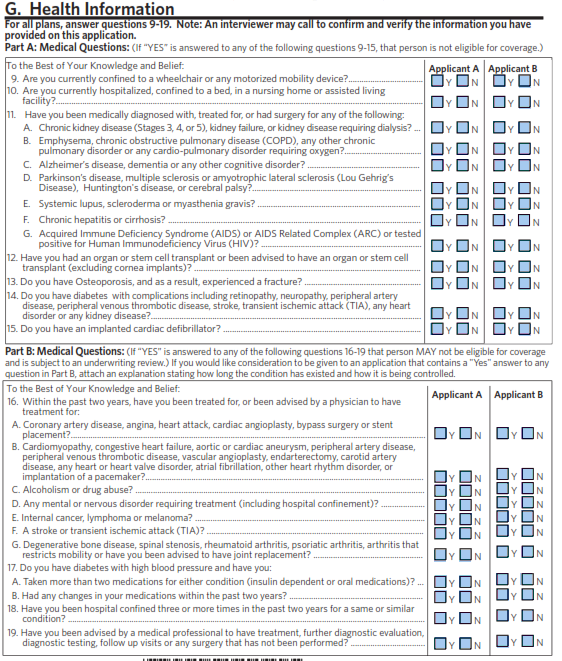
That example also shows why you cannot assume every medical question has the same timeframe.
A company may ask whether something happened in the last two years, the last five years or at any point in your life.
They may also ask about your tobacco use, mobility limitations or whether you need help with activities such as bathing, dressing or eating.
And even when an application does not directly list a particular diagnosis, the company may review your medications. Certain prescriptions can indicate an underlying condition or recent treatment that requires additional review.
Not always.
Some questions are what agents call “knockout questions.” A “yes” answer may make you ineligible for that particular company at that particular time.
Other questions may simply trigger additional review.
The company might request more details, conduct a telephone interview or ask your doctor for records before making a decision.
The final result could be:
But here is the key: being declined by one insurance company does not always mean you would be declined by every company and the decline does not affect your chances with other companies or your current coverage.
One carrier may require five years to have passed since a certain diagnosis. Another may only review the previous two years. One may decline an applicant because of a certain medication, while another company’s guidelines may allow it.
That is why working with a broker that knows the underwriting guidelines for each company rather than just the lowest rate is so important.
Underwriting primarily affects whether the insurance company will accept you and what premium you may be offered.
It does not change the core standardized benefits of the plan. For example, the basic benefits of a standard Plan G are the same regardless of which company sells it. The company cannot remove one of Plan G’s standardized benefits simply because you have diabetes or heart disease.
However, a pre-existing condition waiting period may apply in certain circumstances. Depending on your prior creditable coverage and the circumstances under which you enroll, a company may temporarily delay coverage for costs connected to a pre-existing condition.
That is a separate issue from whether the application itself is approved and should be reviewed before the policy begins.
It is also extremely important to understand that submitting an application is not the same as being approved.
Do not cancel your existing Medicare Supplement policy just because you applied for another one.
Wait until the new insurance company has approved your application, issued the policy and confirmed the effective date. Medicare provides a 30-day free-look period when switching Medigap policies and advises consumers not to cancel their first policy until they have decided to keep the second one. You could have to pay both premiums during that month, but that is much safer than accidentally being left without supplemental coverage. We will also work with you and the company to make sure that the effective date that you choose does not overlap with your old coverage, so that you are not stuck with two premiums.
Never hide a diagnosis or leave out a medication because you are worried about being declined.
Your application becomes part of your insurance contract.
Something important to know is that there is a 2-year contestability period with all Medicare supplement policies. If the company later determines that an important answer was incorrect or incomplete within the two-year period, it may be able to adjust your premium, rescind the policy or deny claims, depending on the circumstances and applicable law. After the two-year contestability period, your coverage cannot be rescinded.
Medicare Supplement applications specifically warn that incomplete, incorrect or untrue answers may give the company the right to rescind coverage or adjust the premium. If they rescind your policy, they do have to pay back all premiums paid to the company, but this could result in your treatment not being paid for.
A knowledgeable agent should never tell you to answer a question inaccurately.
The agent’s job is to understand your health history, interpret the question correctly and determine which company is most likely to consider your application—not to hide information from the insurance company.
A Medicare agent who understands underwriting does much more than compare monthly premiums.
First, the agent should know the health questions and lookback periods for multiple insurance companies.
An agent should be able to recognize that your recent hospitalization might be acceptable with one company but disqualifying with another.
Second, the agent should review your prescriptions.
The name of a medication, the reason it was prescribed and whether you are still taking it can all matter. A good agent may need to ask follow-up questions before recommending a carrier.
Third, the agent should understand guaranteed-issue rights.
You may qualify for protection because you are losing employer coverage, leaving a plan that ended its contract, moving out of a plan’s service area or exercising a Medicare Advantage trial right.
But those rights frequently have deadlines and documentation requirements. Missing a deadline or failing to keep the correct termination notice can affect your ability to prove that you qualify.
Fourth, the agent should understand your state’s rules.
Some states provide additional opportunities to change Medicare Supplement plans without full medical underwriting. These rules may limit which plan you can choose, when you can apply or how much coverage you can add. We have a video on our page about all of the state specific rules around underwriting. Make sure to check it out.
And finally, the agent should know when not to submit an application.
Sometimes it is better to wait until more time has passed since hospitalization, surgery or treatment. Sometimes a different insurance company is a more appropriate option. And sometimes keeping your current policy is safer than risking a coverage change.
No honest agent can guarantee that an underwritten application will be approved. So remember: never cancel your current Medicare Supplement until your new policy has been approved.
However, an agent who understands the guidelines can help you avoid applying to the wrong company, missing a protected enrollment right or canceling valuable coverage too soon.
Before changing a Medicare Supplement policy, speak with an agent who understands the underwriting rules in your state and represents multiple insurance companies.
At Senior Savings Network, we can review your situation, compare your available options and help you understand the underwriting process before an application is submitted.
Book a free appointment today to see if you qualify for a new Medicare Supplement plan:
Book Appointment